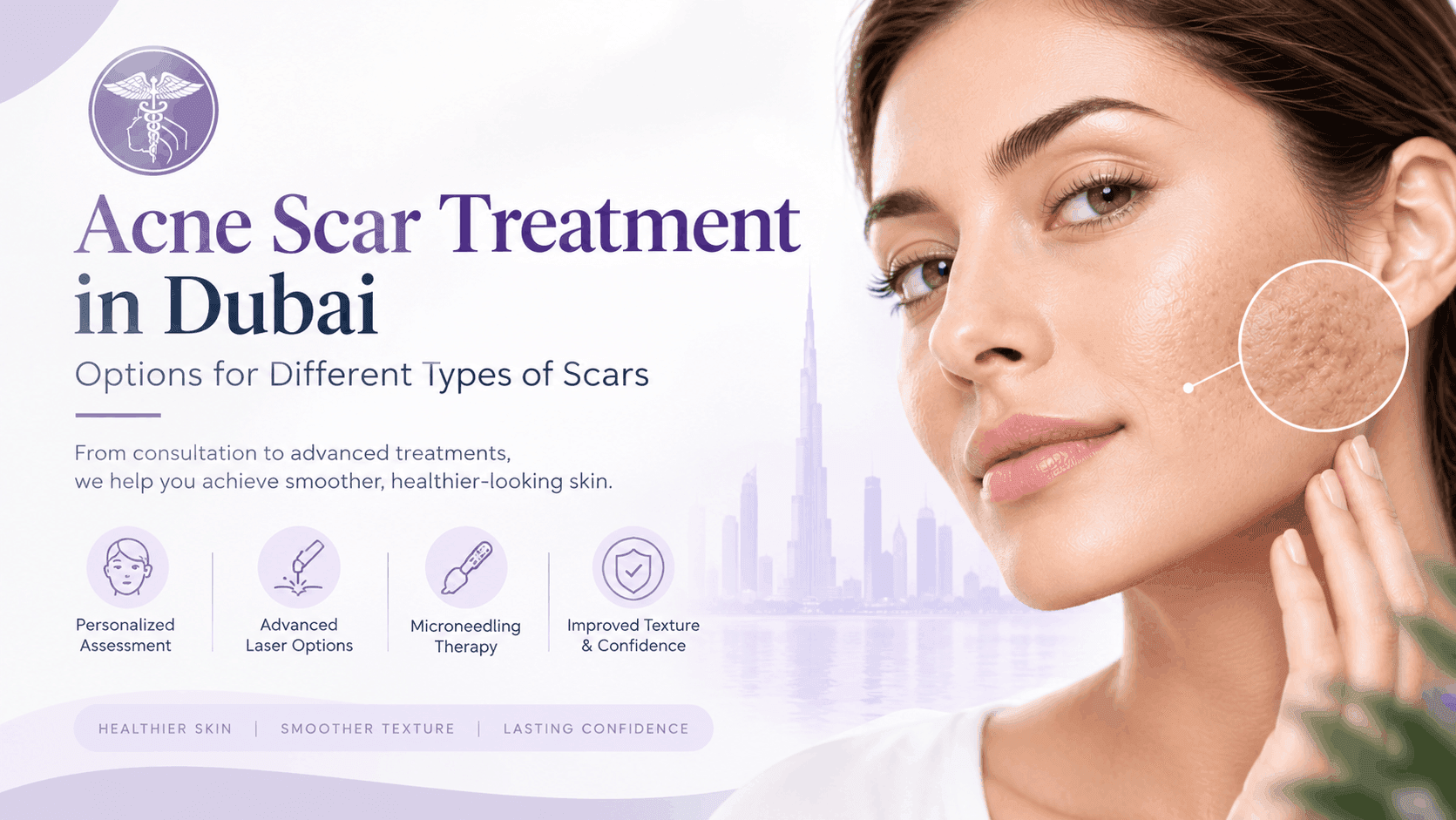
Acne can disappear, but the marks it leaves behind may remain long after active breakouts have settled. For people dealing with uneven texture, depressed scars or persistent discoloration, finding the right acne scar treatment Dubai can be an important part of improving the appearance of the skin.
Acne scars are not all the same. Some are shallow and broad, while others are narrow and deep. Some people also use the term “acne scars” when they are actually dealing with post-acne pigmentation, which requires a different treatment approach.
This is why Acne scar removal Dubai should not be approached as a one-treatment-fits-all procedure.
At Visage Polyclinic Dubai, acne scar treatment should begin with an assessment of the skin, scar type, skin tone, previous treatments and individual goals. Based on that evaluation, a suitable combination of procedures or skincare may be considered.
The objective is usually to improve the appearance of scars rather than promise complete removal.
Acne scars are changes in the skin that can remain after acne inflammation has healed.
They can develop when inflammation damages structures within the skin and the healing process produces an alteration in collagen or tissue.
Acne-related marks can broadly be divided into two categories:
These scars create an indentation in the skin.
Common types include:
Each type has a different shape and depth, which means the same treatment may not work equally well for every scar.
Some people develop raised scars where excess scar tissue forms.
These are different from depressed acne scars and may require a different medical approach.
Dark or red marks left after acne are often mistaken for scars.
Post-inflammatory hyperpigmentation, for example, involves a change in skin color rather than a permanent indentation in the skin.
This distinction is important because a pigmentation-focused treatment may be more appropriate than a procedure designed to remodel depressed scar tissue.
There is no universally appropriate acne scars treatment Dubai procedure.
A doctor may consider several factors before recommending treatment:
Active acne may need to be controlled before certain scar treatments are considered.
Similarly, someone with mainly pigmentation may need a different treatment from someone with deep rolling or ice-pick scars.
A proper assessment therefore helps prevent choosing a procedure simply because it is popular or heavily advertised.
Different treatments can target different aspects of acne scarring. The appropriate option depends on the individual.
Microneedling uses fine needles to create controlled micro-injuries in the skin.
The healing response can stimulate collagen production and may gradually improve the appearance of certain depressed acne scars.
Microneedling may be considered for some patients with:
Multiple treatment sessions may be recommended depending on scar severity and treatment goals.
Recovery can include temporary redness, sensitivity or swelling.
Microneedling is not necessarily suitable for every type of acne scar, particularly deeper or highly defined scars.
Acne scar laser Dubai treatments use laser technology to target specific skin concerns.
Depending on the laser and treatment settings, laser procedures may help improve skin texture, stimulate collagen remodeling or address certain pigmentation concerns.
Different lasers work differently.
Some treatments are more superficial, while fractional laser approaches can target deeper layers of the skin while leaving portions of the surrounding skin untreated.
The appropriate laser depends on factors such as:
People with darker skin tones may require particularly careful treatment selection because some resurfacing procedures can increase the risk of post-inflammatory pigmentation.
Chemical peels can improve the appearance of certain superficial skin concerns.
Depending on the formulation, a peel may help with:
However, chemical peels generally cannot completely correct deep, depressed scars.
A professional assessment is important to distinguish pigmentation from structural scarring before treatment.
For patients interested in this option, a chemical peel Dubai treatment may form part of a broader acne-scar management plan.
Certain depressed scars may sometimes be treated using injectable products to improve the appearance of an indentation.
The purpose is not to treat active acne but to address selected contour irregularities caused by scarring.
Whether an injectable treatment is appropriate depends on scar type, depth, location and surrounding tissue.
Because injectable procedures carry potential risks, they should only be considered after assessment by an appropriately qualified medical professional.
Rolling scars can sometimes be associated with fibrous bands that tether the skin downward.
Subcision is a procedure in which a specialized needle or instrument is used beneath the skin to release selected scar attachments.
The goal is to allow the depressed area to become less tethered.
Subcision is primarily considered for appropriate depressed scars rather than every type of acne scar.
Depending on the patient, it may sometimes be combined with another scar-treatment procedure.
Ice-pick scars are narrow and often extend relatively deeply into the skin.
Because of their shape, broad resurfacing treatments may not always be the most targeted approach.
Certain scar-directed procedures may be considered depending on the depth and characteristics of the individual scar.
A dermatologist or appropriately qualified medical professional should assess these scars before recommending a treatment.
Professional acne scar management does not always begin with a procedure.
Medical skincare may be recommended to support the overall condition of the skin and address issues such as acne, pigmentation or uneven texture.
Ingredients and prescription treatments should be selected according to the patient's skin and medical history.
Skincare may also be used alongside procedures to support the treatment plan.
Many people specifically search for acne scar laser Dubai because laser resurfacing is widely associated with scar improvement.
However, laser is not automatically the right treatment for every scar.
Your clinician may assess:
Fractional laser treatments may be considered for selected acne scars because they can create controlled areas of thermal injury that stimulate skin remodeling.
However, laser treatment can involve redness, swelling, sensitivity and pigmentation changes.
The type of laser, energy settings and treatment schedule should be individualized.
This is one of the most important questions to ask before beginning acne scar removal Dubai treatment.
In most cases, the realistic goal is improvement rather than guaranteed complete removal.
Treatment can sometimes make scars less noticeable by improving:
The amount of improvement varies considerably.
Deep scars may require multiple treatment approaches, while mild scars may respond more readily to less intensive procedures.
A responsible clinician should explain the expected level of improvement before treatment.
The number of sessions depends on the treatment selected and the severity of the scarring.
For example, collagen-remodeling treatments such as microneedling or certain laser procedures may require multiple sessions spaced apart to allow the skin to recover.
Some scar-directed procedures may require fewer sessions but may be combined with other treatments.
Your treatment plan may therefore involve:
Initial skin and scar assessment
Identification of scar type
Treatment selection
A series of procedures if appropriate
Recovery between sessions
Follow-up assessment
Adjustment of the treatment plan if necessary
There is no universal number of sessions that guarantees a particular result.
Recovery depends on the procedure.
After certain treatments, you may experience:
More intensive resurfacing procedures may involve more visible downtime.
Your clinician will provide specific aftercare instructions based on the treatment performed.
Sun protection is particularly important after procedures that make the skin temporarily more sensitive.
Do not pick, scratch or aggressively exfoliate treated skin during recovery unless your clinician specifically instructs you to do so.
When appropriately selected and performed by a qualified professional, acne scar treatments can be used safely for suitable patients. However, every procedure carries potential risks.
Possible complications may include:
The risk profile varies significantly between procedures.
This is why acne scars treatment Dubai should be planned around the patient's skin rather than based solely on a particular device or treatment trend.
Skin tone is an important consideration when planning acne scar treatment.
Some patients, particularly those with medium to darker skin tones, may have a higher risk of post-inflammatory hyperpigmentation after certain procedures.
This does not automatically mean that treatment cannot be performed.
Instead, the practitioner may need to carefully consider:
A personalized treatment strategy can help balance potential benefits and risks.
The cost of acne scar treatment Dubai varies because treatment plans are highly individualized.
Factors that can influence cost include:
For example, a patient requiring a series of microneedling sessions may have a different treatment cost from someone requiring a combination of scar-directed procedures and laser resurfacing.
Rather than relying on an advertised “acne scar removal Dubai” price, ask what is included in the treatment plan.
At Visage Polyclinic Dubai, the recommended treatment and associated cost can be discussed following an individual assessment.
Acne scarring can be complex, and choosing a treatment simply because it is advertised as a quick solution may not produce the outcome you expect.
At Visage Polyclinic Dubai, the assessment should focus on identifying the type and severity of your acne scars before recommending a treatment approach.
Patients can discuss:
This individualized approach is important because two people with “acne scars” may require completely different treatment plans.
If your concerns also include active acne, pigmentation or broader skin-quality issues, your clinician can discuss whether these should be addressed before or alongside scar treatment.
Before booking acne scar laser Dubai or another scar treatment, consider the following:
Check the qualifications and relevant clinical authorization of the person performing the treatment.
Ask whether the practitioner regularly treats the specific type of acne scarring you have.
Discuss the risk of pigmentation and how the treatment will be adapted to your skin tone.
Ask to see authentic patient results where available and appropriately consented.
A responsible clinic should explain limitations as well as potential benefits.
If laser or another device-based treatment is recommended, ask what technology is being used and why it is appropriate for your skin.
If acne scars are affecting the appearance or texture of your skin, the first step is understanding exactly what type of scarring you have.
Whether you are researching acne scar treatment Dubai, acne scar removal Dubai, acne scars treatment Dubai or acne scar laser Dubai, a personalized assessment can help identify the treatment options that may be appropriate for you.
At Visage Polyclinic Dubai, you can discuss your skin history, scar type, treatment goals, potential procedures and expected recovery with the clinic's medical team.
Book a consultation with Visage Polyclinic Dubai to discuss your acne scars and develop an individualized treatment plan.
There is no single treatment that is best for every type of acne scar. The appropriate option depends on whether you have rolling, boxcar, ice-pick, raised scars or mainly post-acne pigmentation.
Complete removal cannot be guaranteed. The realistic goal of acne scar removal Dubai is generally to make scars less noticeable and improve overall skin texture and appearance.
Acne scar laser Dubai treatment uses selected laser technology to target skin texture, collagen remodeling or pigmentation, depending on the device and treatment plan.
Laser treatment can sometimes be performed on darker skin, but the choice of laser and settings requires careful consideration because certain procedures may increase pigmentation risk.
The number of sessions depends on scar type, severity, treatment method and individual response. Multiple sessions may be recommended for some collagen-remodeling treatments.
Chemical peels may help selected superficial marks and pigmentation but generally cannot completely correct deep structural acne scars.
Microneedling may improve the appearance of selected depressed acne scars by stimulating a wound-healing response and collagen remodeling. Suitability depends on scar type and skin condition.
Comfort varies depending on the procedure. Some treatments may involve topical or local anesthesia, while others may cause temporary warmth, tingling or discomfort.
This article is for informational purposes only and does not constitute medical advice. Consult a qualified practitioner for personalised guidance.
Cost varies according to the scar type, treatment method, number of sessions and whether combination procedures are required. An individual consultation provides a more accurate treatment plan.
Sometimes active acne needs to be controlled before certain scar procedures are performed. Your clinician can determine the appropriate sequence based on the severity and type of acne.