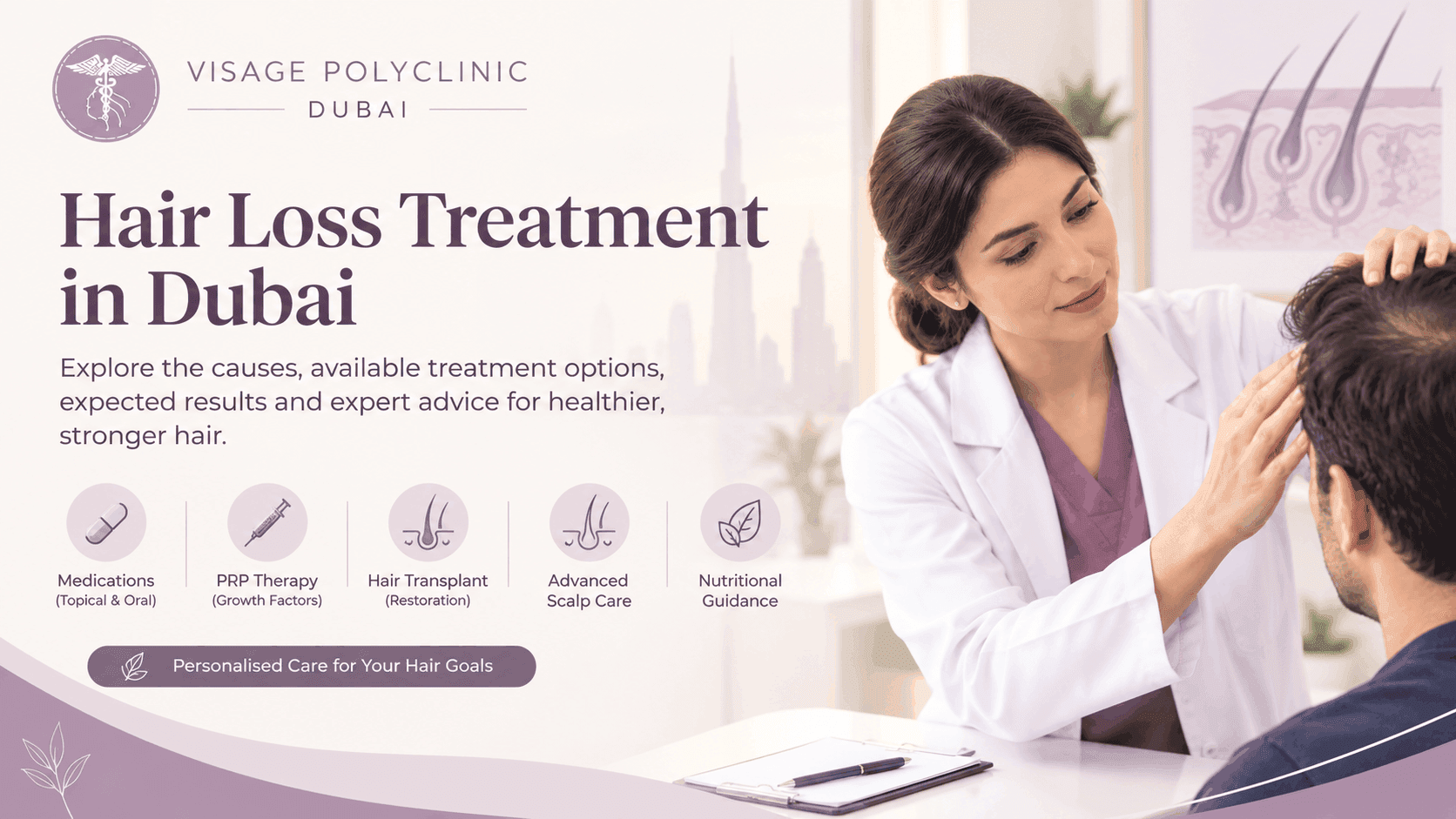
Hair thinning, excessive shedding, a receding hairline or visible patches of hair loss can affect people of different ages and backgrounds. Although some hair shedding is part of the normal hair-growth cycle, persistent or sudden changes may indicate an underlying condition that needs assessment.
If you are researching hair loss treatment in Dubai, understanding the cause is the first step toward choosing an appropriate option. Treatments may include medication, platelet-rich plasma (PRP), targeted scalp care, correction of nutritional deficiencies or hair transplantation, depending on the diagnosis.
There is no single treatment that works for every type of hair loss. The most suitable approach depends on factors such as your hair-loss pattern, medical history, scalp health, age, sex, and whether the hair follicles remain capable of producing hair.
At Visage Polyclinic Dubai, patients can explore suitable treatment options and discuss their concerns with a qualified healthcare professional. A proper assessment helps establish realistic expectations and determine whether further investigation or referral is needed.
Hair loss can occur for several reasons. Identifying the cause is important because a treatment that helps one condition may not be effective for another.
1. Hereditary or Pattern Hair Loss
Androgenetic alopecia, also known as male or female pattern hair loss, is a common cause of gradual thinning.
In men, it often begins with a receding hairline or thinning around the crown. In women, it may appear as a widening part or reduced density across the scalp.
This condition is influenced by genetics and hormones. Treatment often aims to slow further thinning and preserve existing hair, although individual results vary.
2. Stress-Related Hair Shedding
Physical or emotional stress can trigger a temporary increase in hair shedding, a condition commonly known as telogen effluvium.
Potential triggers include significant illness, surgery, childbirth, rapid weight loss and other major physical stressors. Shedding may begin weeks or months after the trigger.
Hair often improves when the underlying cause resolves, but persistent shedding should be evaluated rather than automatically attributed to stress.
3. Nutritional Deficiencies
Insufficient intake or absorption of certain nutrients, including iron, can contribute to hair loss in some people.
Testing may be appropriate when the medical history or examination suggests a deficiency. Supplements should not be taken indiscriminately, as excessive amounts of certain nutrients can also cause harm.
4. Hormonal or Medical Conditions
Thyroid disorders, certain autoimmune conditions, hormonal changes and some medications can affect hair growth.
A clinician may recommend blood tests or further evaluation depending on your symptoms and history.
5. Scalp Disorders
Inflammation, fungal infections and certain scarring scalp conditions can cause hair loss. Some scarring conditions may permanently damage follicles, making early diagnosis particularly important.
Seek medical assessment if hair loss occurs alongside scalp pain, persistent itching, redness, scaling or smooth bald patches.
The right treatment depends on the type of hair loss and the goal of care. Options may include the following.
Medication may be recommended for certain forms of hair loss, especially pattern hair loss.
Topical Minoxidil
Topical minoxidil is an established option for some people with male or female pattern hair loss. It may help maintain existing hair and improve density over time.
Results usually require consistent use, and benefits may diminish if treatment is discontinued. Possible side effects include scalp irritation and unwanted hair growth outside the intended area.
The appropriate formulation and use should be discussed with a healthcare professional, particularly if you have an underlying medical condition or are taking other medication.
Prescription Medication
Certain prescription medications may be appropriate for specific patterns of hair loss. Their suitability depends on the patient's medical history, sex, reproductive considerations and potential side effects.
For example, finasteride may be prescribed for selected men with pattern hair loss. It is not appropriate for everyone and requires a discussion of benefits, risks and precautions.
Do not start, stop or change prescription medication without appropriate medical advice.
Platelet-rich plasma (PRP) is a procedure that uses a concentrated portion of the patient's own blood.
A blood sample is collected and processed to separate the platelet-rich plasma, which is then injected into selected areas of the scalp. Platelets contain growth factors involved in tissue repair, and PRP is being studied for its potential effects on hair growth.
Research suggests PRP may improve hair density in some people with pattern hair loss, but outcomes vary and treatment protocols are not standardized.
PRP may be considered when hair follicles are still present and producing thinner hair. It is not a guaranteed solution for extensive baldness, and maintenance sessions may be needed.
Before proceeding, ask about the expected number of sessions, preparation method, possible side effects and how progress will be assessed.
Learn more about PRP treatment in Dubai.
You can also read our supporting guide: PRP Hair Treatment in Dubai: Does It Help With Hair Loss?.
Hair transplantation is a surgical procedure that moves hair follicles from a donor area, often the back or sides of the scalp, into areas affected by thinning or baldness.
It may be suitable for selected patients with stable pattern hair loss and an adequate donor supply.
Common techniques include follicular unit transplantation (FUT) and follicular unit extraction (FUE). The appropriate technique depends on individual factors and the surgeon's assessment.
Hair transplantation does not prevent untreated hair from continuing to thin elsewhere. Some patients may need ongoing medical treatment to help preserve their existing hair.
Because transplantation is surgery, patients should discuss eligibility, scarring, recovery, risks, realistic density and long-term planning with an appropriately qualified specialist.
When hair loss is triggered by illness, stress, rapid weight loss or a nutritional deficiency, addressing the cause may be the most important step.
Depending on the circumstances, a clinician may recommend:
Temporary shedding may improve once the trigger has resolved, but recovery takes time because hair grows in cycles.
Avoid assuming that every episode of shedding requires injections or cosmetic treatment.
Appropriate scalp care can support general hair and scalp health, but shampoos and cosmetic products do not reliably reverse every cause of hair loss.
A suitable routine may include gentle cleansing, avoiding excessive heat or harsh chemical treatments, and minimizing hairstyles that pull tightly on the hair.
If your scalp is inflamed, painful or persistently itchy, seek medical advice instead of relying only on cosmetic products.
A diagnosis-led approach is more useful than choosing a treatment based on popularity.
Step 1: Identify the Hair-Loss Pattern
A clinician may examine whether your hair loss is gradual or sudden, diffuse or patchy, and concentrated around the hairline, crown or parting.
Step 2: Review Your Medical History
Your history may reveal potential triggers, including illness, weight changes, stress, family history, medications, hormonal changes or nutritional concerns.
Step 3: Examine the Scalp
A scalp examination can help identify signs of inflammation, infection, scarring or pattern hair loss. In some cases, a specialist may recommend additional examination or testing.
Step 4: Arrange Tests if Needed
Blood tests may be recommended when the symptoms or history suggest a medical or nutritional cause. Not everyone needs the same tests.
Step 5: Agree on a Treatment Plan
The clinician should explain the available options, likely benefits, risks, costs, expected timeline and how progress will be monitored.
For some patients, treatment may involve medication. Others may be considered for PRP or transplantation. Some need treatment for an underlying condition before hair-restoration procedures are considered.
Hair growth changes gradually, so most treatments require time before results can be assessed.
The timeline depends on the cause of hair loss and the treatment used.
These are general expectations, not guarantees. Photographs taken under consistent lighting and clinical follow-up can help track progress more reliably than daily visual checks.
Safety depends on the diagnosis, the treatment selected and the qualifications of the person providing it.
Medication can cause side effects or be unsuitable for some patients. PRP injections can cause tenderness, swelling, bruising and, less commonly, infection or other injection-related complications. Hair transplantation carries surgical risks, including infection, scarring, poor growth and an unnatural appearance.
A qualified healthcare professional should review your medical history, explain the risks and determine whether the proposed treatment is appropriate.
Be cautious of clinics or products that promise guaranteed regrowth, permanent results for every patient or a fixed outcome regardless of the cause of hair loss.
The cost of hair loss treatment in Dubai varies considerably because different diagnoses require different approaches.
Factors that can affect the total cost include:
Medication, PRP and hair transplantation have different cost structures. A lower initial price may not reflect the total cost of a complete treatment plan.
Ask for a clear quotation and confirm what is included, such as consultation, follow-up, treatment sessions and maintenance.
When comparing a hair loss clinic in Dubai, consider the quality of assessment and the suitability of the treatment rather than relying on promotional claims alone.
Look for a clinic that:
Assesses the cause of hair loss before recommending treatment.
Explains the potential benefits and limitations of each option.
Discusses possible side effects and alternative treatments.
Uses appropriately qualified and licensed professionals.
Provides realistic timelines and follow-up arrangements.
Recommends medical investigation or specialist referral when needed.
Gives clear pricing without guaranteeing specific results.
If a clinic recommends PRP or another procedure without examining your scalp or asking about your medical history, consider seeking a more thorough assessment.
At Visage Polyclinic Dubai, patients can explore suitable treatment options and discuss their concerns as part of an individualized assessment.
Hair loss can have several different causes, so the first step should be understanding your particular pattern of thinning and what may be contributing to it.
If PRP is considered appropriate, the clinician should explain the treatment process, expected session schedule, potential side effects and realistic outcomes. Where another treatment or further medical assessment is more suitable, that should also be discussed.
Visit the PRP treatment service to learn more about the clinic's PRP offering.
Hair thinning can have several causes, and choosing the right treatment starts with understanding why it is happening.
Whether you are exploring medication, PRP or other hair-restoration options, a professional assessment can help clarify the available choices, potential risks and realistic expectations.
Contact Visage Polyclinic Dubai to discuss your concerns and learn whether its available treatments may be appropriate for your needs.
There is no single best treatment for everyone. Medication, PRP, treatment of an underlying medical cause and hair transplantation may be appropriate for different conditions. An accurate diagnosis helps determine the right option.
Some types of hair loss, especially temporary shedding caused by a reversible trigger, may improve. Pattern hair loss can often be managed, but results depend on the treatment and individual response. Scarring hair loss may cause permanent damage.
PRP may improve hair density in some patients with pattern hair loss. Results vary, and it is not effective for every cause of hair thinning.
A course of initial sessions is commonly recommended, followed by reassessment and possible maintenance. The schedule depends on the diagnosis and the clinician's treatment protocol.
A dermatologist or another appropriately qualified healthcare professional experienced in diagnosing hair and scalp conditions can assess the cause and recommend suitable treatment.
Yes. Deficiencies such as low iron can contribute to hair loss in some people. Testing and supplementation should be guided by medical assessment rather than guesswork.
The treatments have different purposes. PRP may help selected patients with thinning, whereas transplantation moves hair follicles into areas of hair loss. Eligibility, risks, cost and long-term goals determine which option may be appropriate.
Many treatments require several months before meaningful changes can be assessed. The timeline depends on the underlying condition and the treatment used.
This article is for informational purposes only and does not constitute medical advice. Consult a qualified practitioner for personalised guidance.
Some treatments can help slow or manage certain types of ongoing hair loss, but no treatment guarantees that future thinning will stop completely.
Seek assessment if hair loss is sudden, severe, patchy or persistent, or if it occurs with scalp pain, redness, scaling or other symptoms. Early evaluation is especially important when scarring or an underlying medical condition is suspected.