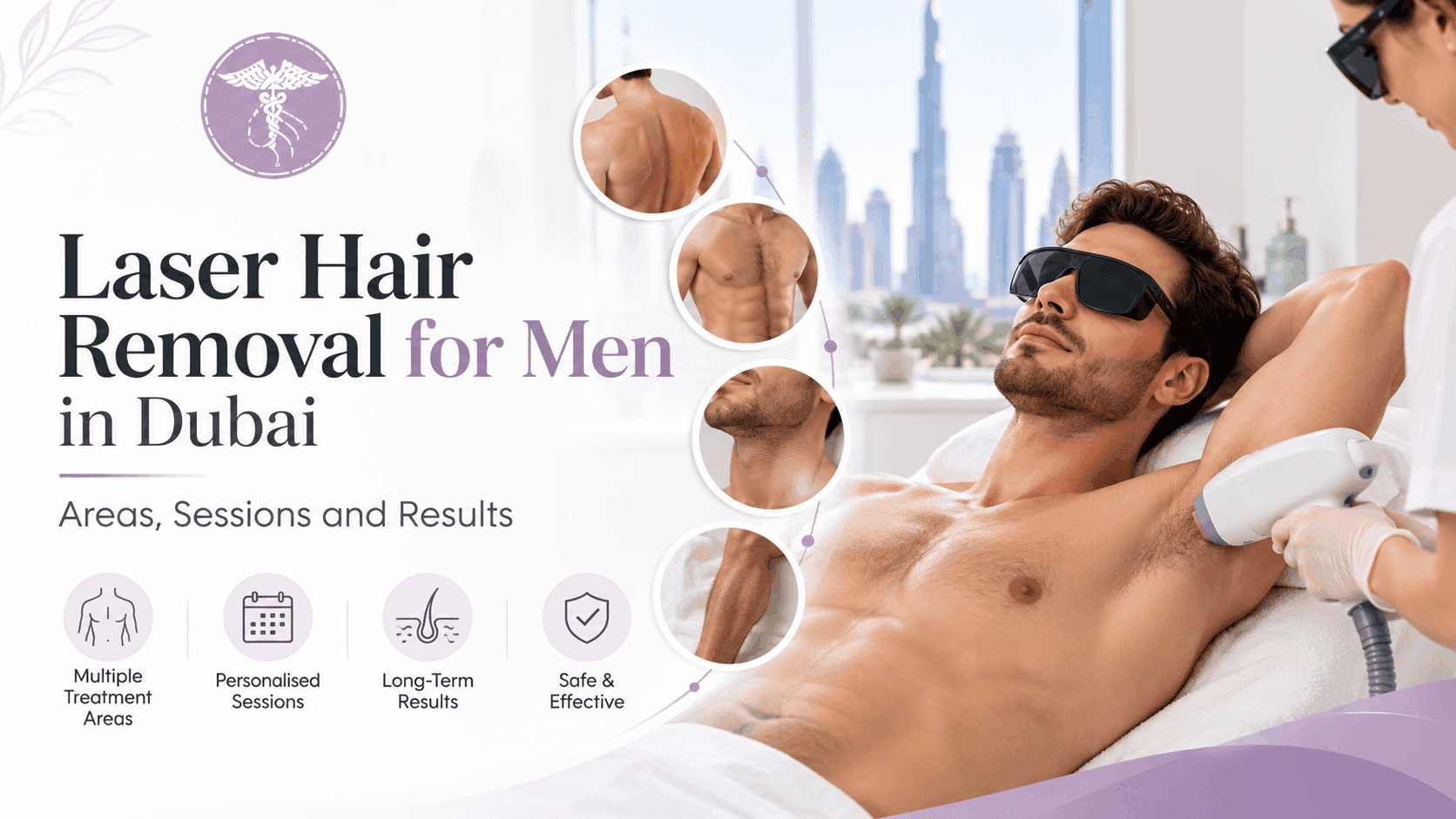
Laser hair removal is increasingly chosen by men who want to reduce unwanted facial or body hair without relying on frequent shaving, waxing or trimming. For some men, the goal is a smoother appearance, while others want to reduce razor bumps, ingrown hairs or the amount of body hair that needs regular maintenance.
Laser hair removal for men in Dubai can be used on several areas, including the back, chest, shoulders, neck, face and legs. The appropriate treatment plan depends on factors such as hair colour, hair thickness, skin tone, treatment area and the stage of the hair-growth cycle.
Laser hair removal works by directing concentrated light toward the pigment in the hair. The energy is absorbed by the hair and can damage the follicle, reducing its ability to produce hair over a series of treatments. Because hair follicles are not all active at the same time, multiple sessions are normally required rather than one treatment.
At Visage Polyclinic Dubai, a consultation can help determine whether laser hair reduction is appropriate for your skin and hair characteristics and what treatment approach may be suitable.
Men may consider laser hair removal for several different reasons.
Shaving can provide short-term results, but it needs to be repeated regularly. Frequent shaving can also cause irritation, razor burn and ingrown hairs in some people.
Laser treatment can progressively reduce the amount and thickness of hair, potentially making regular grooming easier.
Men who experience persistent irritation after shaving may consider laser hair removal as an alternative. The American Academy of Dermatology notes that men with recurring razor burn or ingrown hairs may benefit from laser hair removal because reducing hair growth can reduce the need for repeated shaving.
Some men prefer less hair on areas such as the chest, back, shoulders or legs. Others may want partial reduction rather than complete removal.
The treatment can therefore be planned around individual preferences rather than assuming that every patient wants the same degree of hair reduction.
If you regularly shave, wax or trim large areas, reducing hair growth may simplify your grooming routine over time.
Laser hair removal can be performed on many areas of the body. Common treatment areas for men include:
Back hair is one of the most frequently considered areas for male laser hair removal. Treatment may help reduce dense hair and make regular grooming easier.
Shoulders can also be treated, although the exact approach depends on hair density and the patient's skin and hair characteristics.
Men may choose chest or stomach treatment when they want to reduce dense body hair while retaining some natural appearance.
The treatment plan can be adjusted according to the desired level of reduction.
Laser hair removal can be considered for selected areas of the beard and neck, particularly for men who experience frequent shaving irritation.
Facial treatment requires careful assessment because facial hair can be dense and hormonally influenced.
Some men choose full or partial treatment of their arms or legs. This may be relevant for personal grooming, sports or simply a preference for reduced body hair.
Underarm laser hair removal can reduce the need for frequent shaving or trimming and may be selected as an individual treatment area or alongside larger body areas.
The AAD lists the back, chest, legs, neck, shoulders, armpits and face among areas that can be treated with laser hair removal.
One of the most common questions about laser hair removal for men in Dubai is how many sessions are necessary.
There is no universal number because treatment response varies from person to person. The AAD states that many patients require a series of treatments, with its patient guidance commonly describing around 2–6 treatments and noting that some people may require six or more.
Men with dense or coarse hair may have different treatment requirements from someone with finer hair. Large body areas may also require a different schedule from smaller areas such as the neck or underarms.
Hair grows in cycles. Laser treatment is most effective when targeted hair is in an appropriate growth phase.
Because individual hairs are at different stages of growth at any one time, a single session cannot effectively target every follicle.
This is why treatments are spaced apart rather than performed repeatedly on consecutive days.
The AAD reports that many patients have treatments approximately every 4–6 weeks, although the appropriate interval depends on the individual and the treatment area.
Your treatment plan may depend on several factors.
Dark, coarse hair generally provides more pigment for the laser to target than very light or fine hair.
Laser hair removal is generally less effective for blonde, white, grey and red hair because these hair colours contain less of the pigment targeted by many laser systems.
Skin colour is an important consideration when choosing laser parameters and technology.
Modern laser systems can be used for a wider range of skin tones, but darker skin requires careful treatment planning because excess energy can increase the risk of burns or pigmentary changes.
Dubai Health Authority guidance discusses different laser technologies and their suitability for different skin types. For example, its current non-surgical cosmetic procedure standards describe diode lasers as effective for darker skin types and long-pulse Nd lasers as usable across skin types, including tanned patients.
The specific technology and settings should always be selected following an appropriate assessment rather than simply choosing a laser based on marketing claims.
The face, neck, chest, back and legs can respond differently.
Areas affected more strongly by hormones may also require individualized expectations and maintenance treatments.
Hormones influence hair growth. If a man's hair growth pattern changes because of an underlying hormonal or medical issue, the treatment plan may need to take this into account.
A consultation is important if hair growth has changed suddenly or is unusually excessive.
Before treatment, the skin and hair are assessed and the treatment area is prepared.
The laser device is then applied to the selected area using settings chosen for the patient's skin and hair characteristics. Protective eyewear is required during laser treatment. Patients commonly describe the pulses as warm pinpricks or a snapping sensation.
Treatment time varies significantly.
A small area such as part of the face may take only a few minutes, while large areas such as the back or legs can take considerably longer.
The exact process at Visage Polyclinic Dubai will depend on the treatment area, equipment used and individual assessment.
Results develop progressively rather than all at once.
The AAD reports that patients may see approximately 10%–25% hair reduction after the first treatment, although results vary based on factors including hair colour and thickness, skin colour, treatment area and laser type.
With additional sessions, treated hair can become less noticeable, finer and lighter.
Some patients remain hair-free for months or even years after completing treatment, while others experience regrowth and require maintenance sessions.
It is therefore more accurate to describe laser hair removal as long-term hair reduction rather than promising that every follicle will permanently disappear.
Preparation can influence both safety and treatment effectiveness.
Your clinician may provide individual instructions, but important considerations include:
The AAD recommends discussing factors such as recent tanning, scarring tendencies, medications and previous skin reactions during the consultation.
Laser hair removal can be performed safely when the treatment is appropriately selected and delivered by qualified professionals with suitable experience.
However, it is not completely risk-free.
Common short-term effects can include redness, swelling and discomfort. Less common complications can include blistering, infection, scarring and changes in skin pigmentation.
This makes practitioner experience particularly important.
For treatment in Dubai, it is sensible to choose a properly licensed healthcare facility and ask who performs the procedure, what experience they have with your skin type and what laser technology is being used.
Dubai Health Authority standards specifically address laser and IPL hair-reduction services, including laser safety, skin and hair anatomy, hair-growth cycles and different skin types.
Comfort varies between individuals and treatment areas.
Many patients describe the laser pulses as a warm snapping or pinprick sensation. The level of discomfort can depend on hair thickness, treatment area, laser settings and individual sensitivity.
Large areas with dense, coarse hair may feel more noticeable than smaller areas.
A consultation allows the treatment provider to discuss what you are likely to experience and what comfort measures may be appropriate.
Laser hair removal generally does not require significant downtime.
Immediately after treatment, the skin may look red or slightly swollen, similar to a mild sunburn. These effects are often temporary.
After treatment, men should follow the clinic's aftercare instructions and protect the treated skin from direct sunlight.
If you experience severe or persistent irritation, blistering, significant pigment changes or other concerning symptoms, contact your healthcare provider promptly.
Choosing a clinic for men's laser hair removal in Dubai should involve more than comparing promotional prices.
At Visage Polyclinic Dubai, treatment planning should begin with an assessment of your skin, hair characteristics, treatment goals and the areas you want to address.
A personalized approach is particularly important for men because body hair can be dense, coarse and distributed across large treatment areas.
Before proceeding, ask about:
You can also explore Visage's broader aesthetic services through the Aesthetic Treatments page.
A good consultation should be focused on your individual characteristics rather than promising identical results for everyone.
Consider whether the clinic:
Performs a proper skin and hair assessment.
Explains realistic treatment expectations.
Uses appropriate laser technology for your skin type.
Discusses possible risks and side effects.
Provides clear preparation and aftercare instructions.
Has appropriately qualified and licensed professionals.
Can explain the expected treatment schedule.
Uses suitable safety precautions, including protective eyewear.
The AAD specifically recommends asking about the practitioner's experience with your skin colouring, expected number of treatments, potential side effects, expected results and treatment cost before proceeding.
If shaving, waxing or frequent trimming has become time-consuming, laser hair removal for men in Dubai may be an option worth discussing.
The right treatment plan depends on your skin tone, hair characteristics, treatment areas and desired level of reduction. A professional consultation can help establish realistic expectations, determine suitable treatment parameters and explain the likely number of sessions.
Contact Visage Polyclinic Dubai to discuss your goals and find out whether male laser hair removal is appropriate for you.
Yes. Men commonly use laser hair removal for facial and body areas such as the back, chest, shoulders, neck, legs and underarms. Suitability depends on individual skin and hair characteristics.
There is no fixed number. Many patients require multiple sessions, commonly several treatments spaced weeks apart. The AAD notes that some patients need 2–6 treatments, while others may require six or more.
There is no single best area. Popular choices include the back, chest, shoulders, neck, underarms, face and legs. The appropriate area depends on your grooming goals.
Yes, selected facial and beard areas can be treated. However, facial hair can be dense and hormonally influenced, so expectations and treatment planning should be individualized.
Laser treatment can provide long-term hair reduction, and some treated areas may remain hair-free for months or years. Regrowth can occur, and maintenance treatments may sometimes be needed.
Laser hair removal can be performed on darker skin, but the treatment requires appropriate technology and settings. DHA guidance identifies laser options that can be used for darker skin types.
Laser treatment is generally less effective on blonde, white, grey or red hair because there may be insufficient pigment for the laser to target effectively.
Many patients are treated approximately every 4–6 weeks, but the appropriate interval varies according to the treatment area and individual hair-growth cycle.
This article is for informational purposes only and does not constitute medical advice. Consult a qualified practitioner for personalised guidance.
It may help men who experience razor burn or ingrown hairs because reducing hair growth can reduce the need for frequent shaving.
The cost varies depending on the treatment area, number of areas treated, number of sessions required, technology and individual treatment plan. A consultation is the best way to receive an accurate recommendation and quotation.